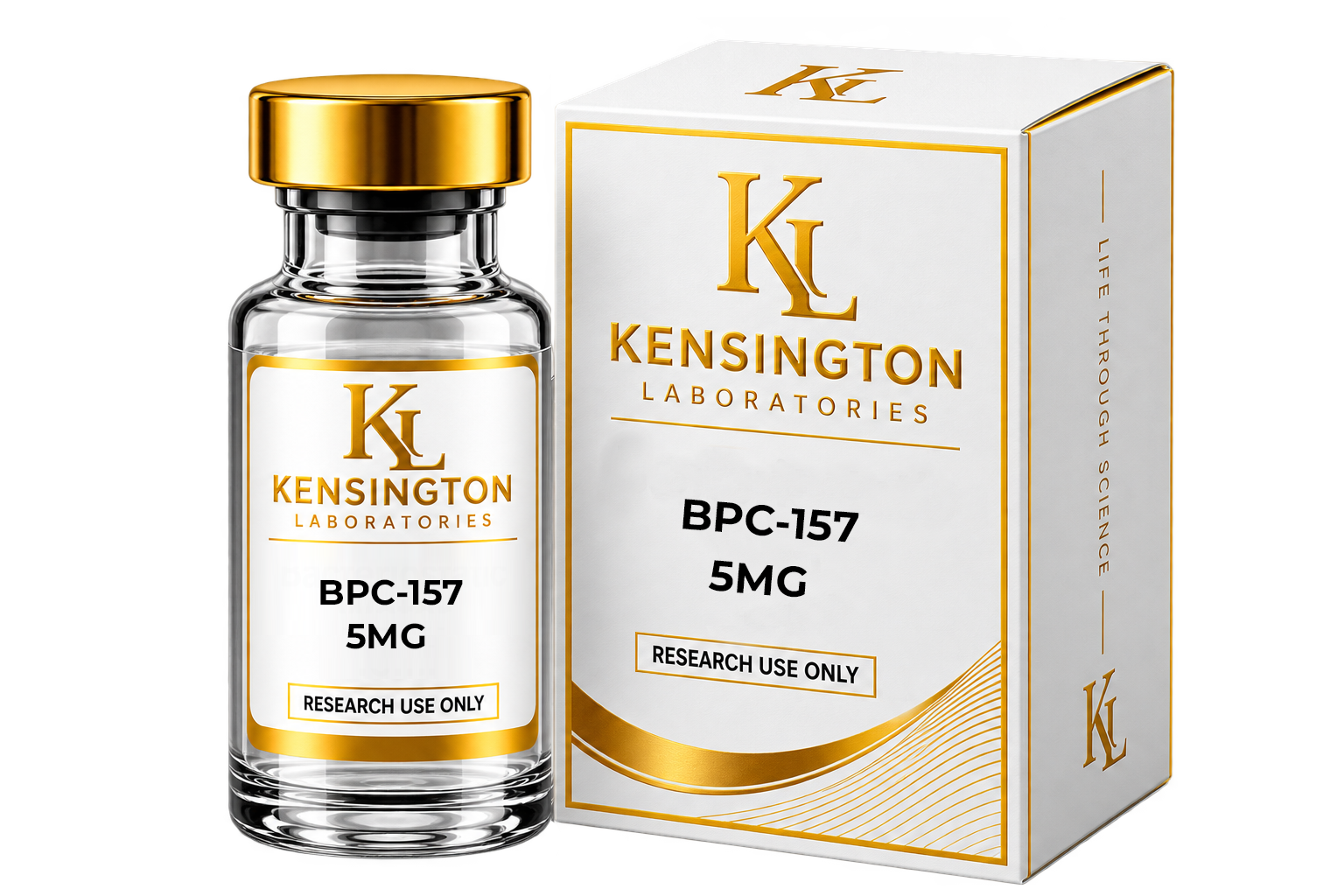
Description
OVERVIEWProduct overview
BPC-157, or Body Protection Compound 157, is a synthetic pentadecapeptide made up of fifteen amino acids. Its sequence is derived from a protective protein fragment originally identified in gastric juice, which is why it is frequently described in the literature as a stable gastric pentadecapeptide.
Laboratory interest in BPC-157 centres on connective tissue and mucosal biology. Published preclinical work has examined its relationship with fibroblast migration, collagen organisation, angiogenic signalling and nitric-oxide pathways in models of tendon, ligament, muscle, skin and gastrointestinal injury.
The majority of published findings come from rodent and in-vitro models. Results have not been confirmed by large, controlled human trials, and BPC-157 is not licensed as a medicine in the United Kingdom, Ireland or the European Union.
SUPPLY IN IRELANDBPC-157 Ireland — supplied to research laboratories
Research groups across Ireland buy BPC-157 from Kensington Laboratories as a lyophilised BPC-157 peptide, released only against a batch-matched certificate of analysis. Every vial of high purity BPC-157 is verified by HPLC and LC-MS before it leaves the facility, so laboratories ordering BPC-157 in Ireland receive material with documented purity and identity.
Laboratory BPC-157 is packed for controlled storage and sent by tracked delivery in 3–5 days to Dublin, Cork, Galway, Limerick and the rest of Ireland. Delivery costs €9.90 per order. Teams planning BPC157 research can review the specifications, certificate of analysis and reference list on this page before ordering.
Institutions searching for BPC-157 peptide suppliers in Ireland typically compare purity, batch documentation and delivery times. Each of those is published here: a 99% HPLC purity specification, a certificate matched to the batch code on your vial, and tracked delivery in 3–5 days.
BPC-157 is supplied strictly for laboratory research use only. It is not a medicine and is not for human or veterinary consumption.
SPECIFICATIONSProduct specifications
- Purity: ≥ 99% (HPLC)
- Appearance: White lyophilised powder
- Quantity: 5 mg or 10 mg per vial
- CAS number: 137525-51-0
- Molecular formula: C62H98N16O22
- Molecular weight: 1419.53 g/mol
- Sequence: GEPPPGKPADDAGLV
- Solubility: Soluble in bacteriostatic or sterile water
- Storage temperature: Store at 2–8°C; long-term −20°C, protected from light
- Shelf life: 24 months lyophilised; 30 days reconstituted at 2–8°C
- Manufacturing standard: ISO 9001 facility, GMP-aligned solid-phase synthesis
- Batch information: Batch number and expiry printed on every vial label
RESEARCHResearch overview
The following summary is provided for educational and scientific context only. It describes what has been observed in published laboratory and animal studies and does not represent established clinical outcomes, medical advice or a claim of efficacy in humans.
Background
BPC-157 was first described in the 1990s by research groups investigating protective fragments of gastric juice protein. Unlike many peptides, it demonstrated notable stability in gastric acid and aqueous solution, which made it a practical candidate for oral and parenteral administration in animal experiments.
Since then it has appeared in several hundred preclinical publications, largely from a small number of research groups, covering gastrointestinal, musculoskeletal, vascular and neurological models.
Current research areas
Published investigation clusters around a handful of biological themes. Each remains experimental and none has been established as a therapeutic effect in humans.
- Tendon and ligament models — fibroblast outgrowth, migration and survival under stress
- Collagen biology — deposition, cross-linking and organisation during experimental healing
- Angiogenesis — endothelial tube formation and blood-flow recovery in ischaemia models
- Nitric-oxide signalling — interaction with eNOS activity and vascular tone
- Gastrointestinal mucosa — protective effects in ulcer and colitis models
- Neurovascular and muscle injury models — functional recovery endpoints
Scientific context and proposed mechanisms
In tendon cell models, BPC-157 has been associated with increased fibroblast migration and spreading, with authors linking the effect to activation of the FAK–paxillin signalling pathway involved in cell adhesion and movement.
A separate line of work proposes involvement of the VEGFR2–Akt–eNOS axis. In a rat hind-limb ischaemia model, BPC-157 administration was reported to increase VEGFR2 expression and improve blood-flow recovery, suggesting a pro-angiogenic influence in that setting.
The precise pharmacology, receptor interaction, effective dose range and long-term safety profile of BPC-157 remain unknown. Findings across studies are heterogeneous in species, route, dose and endpoint, which limits direct comparison.
Interpreting the evidence
Readers should note that most published work uses rodent models, small group sizes and short observation windows. Independent replication is limited, and outcomes in animal soft-tissue healing are strongly influenced by loading, rehabilitation and nutrition — variables that are difficult to control.
There is currently no regulatory-approved human dosing protocol for BPC-157. Any laboratory protocol should be defined by the model under study, institutional ethical approval, appropriate controls and predefined endpoints.
References
- Chang CH, Tsai WC, Lin MS, et al. The promoting effect of pentadecapeptide BPC 157 on tendon healing involves tendon outgrowth, cell survival, and cell migration. Journal of Applied Physiology, 2011. https://pubmed.ncbi.nlm.nih.gov/21030672/
- Hsieh MJ, Liu HT, Wang CN, et al. Therapeutic potential of pro-angiogenic BPC157 is associated with VEGFR2 activation and up-regulation. Journal of Molecular Medicine, 2017. https://pubmed.ncbi.nlm.nih.gov/28593442/
- Gwyer D, Wragg NM, Wilson SL. Gastric pentadecapeptide body protection compound BPC 157 and its role in accelerating musculoskeletal soft tissue healing. Cell and Tissue Research, 2019. https://pubmed.ncbi.nlm.nih.gov/30915550/
- Sikiric P, Seiwerth S, Rucman R, et al. Stable gastric pentadecapeptide BPC 157: novel therapy in gastrointestinal tract. Current Pharmaceutical Design, 2011. https://pubmed.ncbi.nlm.nih.gov/21443489/
- Chang CH, Tsai WC, Hsu YH, Pang JHS. Pentadecapeptide BPC 157 enhances the growth hormone receptor expression in tendon fibroblasts. Molecules, 2014. https://pubmed.ncbi.nlm.nih.gov/25153857/
CERTIFICATE OF ANALYSISIndependent batch testing
Every released batch is independently tested. Match the batch number on the vial to the certificate published online.
- Batch number
- KL-BPC157-2409A
- Testing laboratory
- Janoshik Analytical, s.r.o.
- Date tested
- 12 August 2026
- Reported purity
- 99.42%
- Method
- RP-HPLC with UV detection at 214 nm, confirmed by LC-MS