Description
OVERVIEWProduct overview
This peptide corresponds to a short region of thymosin beta-4 that includes the sequence associated with actin binding. It is used where a research question concerns a defined part of the parent molecule rather than the whole fragment.
Working with a shorter sequence lets a laboratory separate effects attributable to the actin-binding motif from those requiring the wider peptide.
Evidence is limited and entirely preclinical. Nothing here is a medicine or a treatment.
SUPPLY IN IRELANDTB-500 Frag 17-23 Ireland — supplied to research laboratories
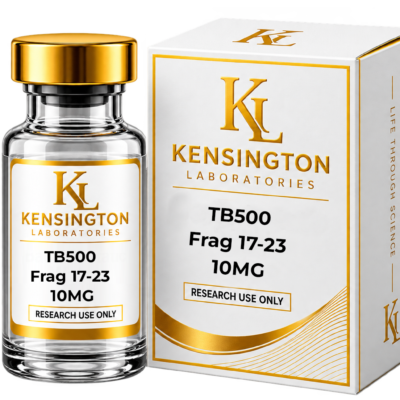
Research groups across Ireland buy TB-500 Frag 17-23 from Kensington Laboratories as a lyophilised TB-500 Frag 17-23 peptide, released only against a batch-matched certificate of analysis. Every vial of high purity TB-500 Frag 17-23 is verified by HPLC and LC-MS before it leaves the facility, so laboratories ordering TB-500 Frag 17-23 in Ireland receive material with documented purity and identity.
Laboratory TB-500 Frag 17-23 is packed for controlled storage and sent by tracked delivery in 3–5 days to Dublin, Cork, Galway, Limerick and the rest of Ireland. Delivery costs €9.90 per order. Teams planning TB500Frag1723 research can review the specifications, certificate of analysis and reference list on this page before ordering.
Institutions searching for TB-500 Frag 17-23 peptide suppliers in Ireland typically compare purity, batch documentation and delivery times. Each of those is published here: a 99% HPLC purity specification, a certificate matched to the batch code on your vial, and tracked delivery in 3–5 days.
TB-500 Frag 17-23 is supplied strictly for laboratory research use only. It is not a medicine and is not for human or veterinary consumption.
SPECIFICATIONSProduct specifications
- Purity: ≥ 99% (HPLC)
- Appearance: White lyophilised powder
- Quantity: 10 mg per vial
- Peptide class: Short synthetic fragment corresponding to residues 17–23 of thymosin beta-4
- Also known as: Thymosin beta-4 fragment 17-23, actin-binding domain fragment
- Solubility: Soluble in bacteriostatic or sterile water
- Storage temperature: Store at 2–8°C; long-term −20°C, protected from light
- Shelf life: 24 months lyophilised; 30 days reconstituted at 2–8°C
- Manufacturing standard: ISO 9001 facility, GMP-aligned solid-phase synthesis
- Batch information: Batch number and expiry printed on every vial label
RESEARCHResearch overview
The following summary is provided for educational and scientific context only. It describes what has been observed in published laboratory and animal studies and does not represent established clinical outcomes, medical advice or a claim of efficacy in humans.
Background
This peptide corresponds to a short region of thymosin beta-4 that includes the sequence associated with actin binding. It is used where a research question concerns a defined part of the parent molecule rather than the whole fragment.
Working with a shorter sequence lets a laboratory separate effects attributable to the actin-binding motif from those requiring the wider peptide.
Evidence is limited and entirely preclinical. Nothing here is a medicine or a treatment.
Current research areas
Published investigation clusters around a small number of biological themes. Each remains experimental and none has been established as a therapeutic effect in humans.
- Structure–activity comparison against full-length TB-500
- Actin-binding motif studies
- Cell migration and wound-closure assays
- Fragment stability and handling in solution
Scientific context and proposed mechanisms
The fragment carries the short motif that authors associate with actin interaction, which is why it appears in structure–activity work alongside longer thymosin beta-4 sequences.
Whether the isolated fragment reproduces the full range of reported parent-molecule effects is an open experimental question.
Interpreting the evidence
Most published work in this area uses cell culture or rodent models with small group sizes and short observation windows. Independent replication varies considerably between compounds, and results are sensitive to species, route, dose and endpoint.
There is no regulatory-approved human protocol for this compound. Any laboratory protocol should be defined by the model under study, institutional ethical approval, appropriate controls and predefined endpoints.
References
CERTIFICATE OF ANALYSISIndependent batch testing
Every released batch is independently tested. Match the batch number on the vial to the certificate published online.
- Batch number
- KL-TB500FRAG1-2407A
- Testing laboratory
- Janoshik Analytical, s.r.o.
- Date tested
- 2 July 2026
- Reported purity
- 99.38%
- Method
- RP-HPLC with UV detection at 214 nm, confirmed by LC-MS
The independent result for this batch is summarised above. Contact the laboratory team if you need the full report for this batch.